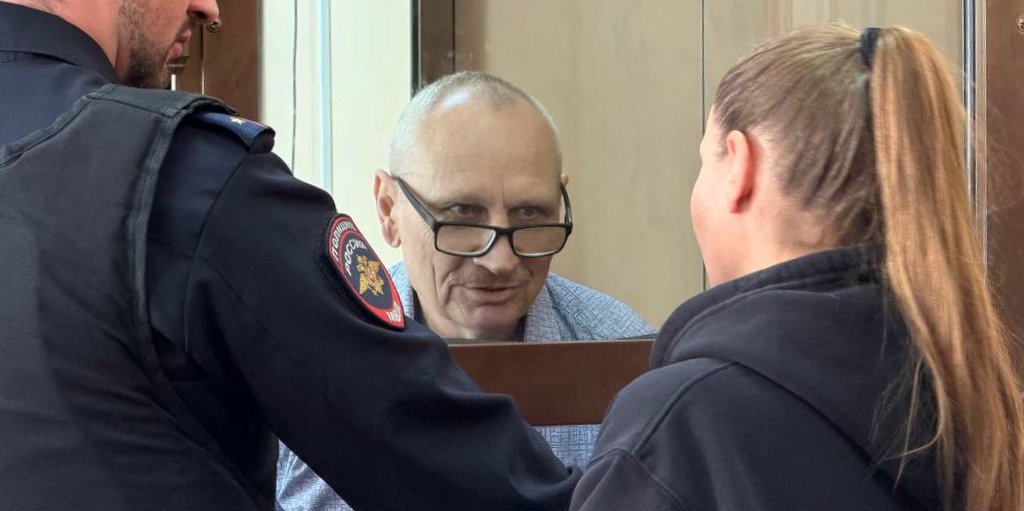
Aleksandr Paysov in the cage at one of the court hearings, October 2026.
Aleksandr Paysov in the cage at one of the court hearings, October 2026.
In the Moscow Region, Court Sentenced a Postman from Zvenigorod to a Penal Colony
Moscow RegionOn October 20, 2026, the Odintsovo City Court of the Moscow Region announced the verdict against Aleksandr Paysov, 64, finding him guilty of participating in the activity of an extremist organization. The believer was sentenced to 2 years in a penal colony.
"I want to continue caring for my mother and to be involved in the lives of my daughter and granddaughter," Aleksandr stated in his final statement. "There are things I can do to be useful. I do not pose any danger to anyone, especially not to the state. I just want to live an honest, peaceful life."
The criminal case against Paysov was initiated in December 2025. Investigators conducted searches at several addresses; Aleksandr was detained and sent the following day to the pretrial detention center in Volokolamsk. The reason for the criminal prosecution was his discussion of the Bible with a man who turned out to be an undercover agent of the security services.
By the time the verdict was announced, Paysov had spent about 10 months in custody. One of the difficulties was that he was held in cells for smokers. Letters from caring people became a source of support for Aleksandr: on one occasion, he received 50 letters at once.
In addition, he was constantly worried about his elderly mother. "For the past 20 years I have been caring for my elderly mother, who is now a person with a disability," Aleksandr said before the verdict was issued. "Everything—from cleaning, to cooking, to monitoring her expensive medication—was my responsibility. Because of my arrest, her condition seriously worsened."
The court proceedings lasted less than 3 months. The court did not review the case materials in detail; the prosecutor merely flipped through the pages, reading out the titles of the documents without addressing their content. The defense requested that the case be returned to the prosecutor's office, referring to the opinion of the UN Working Group on Arbitrary Detention, which recognized the criminal prosecution of Jehovah's Witnesses in Russia as arbitrary and discriminatory, but the court did not grant the motion.
In Moscow and the Moscow Region, 35 of Jehovah's Witnesses have already faced criminal prosecution: 18 of them received prison terms, and 4 women were sentenced to compulsory labor.
