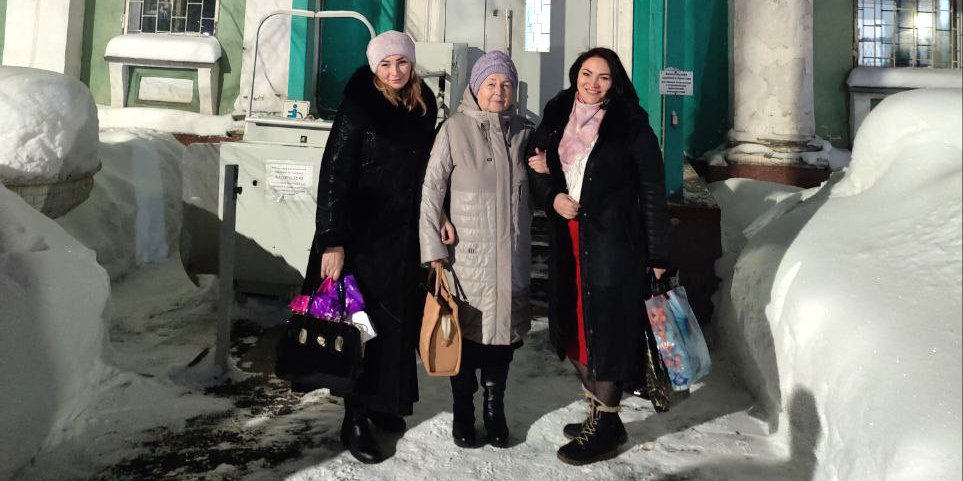
From left to right: Larisa Serdtseva, Nina Smirnova, and Zhanna Zhavoronkova at the courthouse. January 2025.
From left to right: Larisa Serdtseva, Nina Smirnova, and Zhanna Zhavoronkova at the courthouse. January 2025.
“What's the Crime? Kindness?” Verdict Against Three Women — Jehovah’s Witnesses from Shakhunya
Nizhegorod RegionOn January 30, 2026, at the Shakhunya Interdistrict Court of the Nizhny Novgorod Region, Nina Smirnova, Larisa Serdtseva, and Zhanna Zhavoronkova heard the verdict in their case. Judge Artemiy Lunegov handed the believers a 2.5-year suspended sentence "for participating in the activity of an extremist organization."
Nina Smirnova, 75, is a retired accountant. Her husband does not share her religious beliefs. "He is severly disabled; he also has atherosclerosis in his legs, and it is very difficult for him to walk. Nevertheless, he attended every court hearing to support me," the believer said about her family circumstances. Larisa Serdtseva, 50, is a seamstress who worked for a cleaning company before the prosecution began. She and her husband have three daughters, two of whom are still at school. Zhanna Zhavoronkova, 43, worked most of her life for the railway.
The local branch of the Ministry of Internal Affairs initiated the case against these residents of Shakhunya in February 2024. "We endured a search and, since then, have repeatedly faced emotional pressure from some law enforcement officers," Zhanna recalled. "It affected my health — in November I suffered a stroke." They read out her charges right in the hospital. Zhanna also lost her job due to media harassment during the criminal prosecution: "Although I was physically weak after the stroke, I was forced to take a new job. This drastically complicated life for me and my loved ones, since I could not care for my bedridden father properly."
The case materials included testimony from two women, Yamorozova and Nepomnyashchikh. The investigation deemed conversations with them to be evidence of a crime. One of them died before the trial. The defense asked that her testimony be excluded, pointing to contradictions that could not be resolved without questioning the person, but the court refused. The believers emphasized that only the Bible was discussed in conversations with these women. "Is it my fault that [Yamorozova] urged me to talk with her on subjects that interested her? ... And feeling compassion for her difficult life I sometimes visited her. What's the crime? Kindness?" Larisa asked rhetorically in her final statement.
"Who after all was recruited, and into what?" Serdtseva asked in disbelief at the charge. "The witnesses who testified against me had their own faith before meeting me, and they kept it afterward."
Since 2017, in Russia, 226 women — Jehovah's Witnesses — have faced criminal prosecution for their faith; 89 of them are over 60.


